What Is Oxidative Stress and Why Does It Matter?
Oxidative stress refers to an imbalance between free radicals and antioxidants in the body.
Basically, the body continually produces free radicals and antioxidants strive to control and neutralize them. Oxidative stress may arise when the production of free radical surpasses the body’s capacity to maintain antioxidant defenses.
An excess of free radicals can harm body essential cellular components, including lipids, proteins, carbohydrates, and DNA. The harm to these molecules interferes with regular cell operations and could result in inflammation, cellular malfunction, and potentially cell death via processes such as apoptosis or necrosis. As time passes, this buildup of harm can affect tissues and organs across the body.
Researchers consider oxidative stress to be one of the fundamental mechanisms involved in aging and the development of many chronic diseases. Scientific evidence has linked oxidative stress to cardiovascular diseases, atherosclerosis, diabetes, liver and kidney disorders, neurodegenerative conditions such as Alzheimer’s disease and Parkinson’s disease, certain cancers, and various inflammatory disorders. Because oxidative stress contributes to cellular deterioration over time, it is also closely associated with the natural aging process and age-related health decline.
Free Radicals: How They Form in the Body
Free radicals are highly reactive molecules that can be naturally produced inside the body. They are formed as part of different biological processes, including normal cellular metabolism. Because they are reactive, free radicals can interact with other molecules and potentially contribute to oxidative damage when their levels become difficult for the body’s antioxidant defenses to control.
One important group of reactive molecules is called reactive oxygen species (ROS). ROS are oxygen-containing molecules that can react with other substances in cells. Some ROS are free radicals, while others are not technically free radicals but are still highly reactive. Therefore, the terms free radicals and ROS are related but do not mean exactly the same thing.
How Are Free Radicals and ROS Produced?
Free radicals and reactive oxygen species (ROS) are naturally produced in the body as part of normal physiological processes. They are mainly formed when cells use oxygen to produce energy, especially inside the mitochondria. During this process, a small amount of oxygen can be converted into reactive molecules such as superoxide, hydrogen peroxide, and hydroxyl radicals.
ROS can also be produced by certain enzymes and immune cells. For example, immune cells generate ROS to help destroy bacteria and other harmful microorganisms. This means that ROS are not always harmful—they have important roles in normal cell signaling, immune defense, and other biological processes.
However, ROS production can increase under certain conditions, including inflammation, infection, intense physical activity, smoking, alcohol consumption, pollution, radiation, and exposure to certain chemicals or drugs. When ROS production becomes too high and the body’s antioxidant defenses cannot neutralize them effectively, oxidative stress can occur. This imbalance may damage important cellular components such as lipids, proteins, and DNA.
What Are Reactive Oxygen Species (ROS)?
Reactive oxygen species are a group of oxygen-containing molecules with different levels of reactivity. Some are free radicals because they contain an unpaired electron, while others are non-radical reactive molecules.
Their ability to react with surrounding molecules is what makes them important in oxidative stress research. If excessive oxidative reactions occur, important cellular components such as lipids, proteins, and DNA can become targets of oxidative damage.
The scientific literature in the provided source discusses ROS and reactive nitrogen species (RNS) as having both physiological and pathological effects, emphasizing that reactive species are not exclusively harmful.
Where Do Reactive Species Come From?
Reactive species can be generated through several processes within the body. The most important point for understanding this topic is that their formation can occur naturally during normal physiological activity.
They may also increase under conditions that place greater oxidative pressure on the body. However, the exact sources and amounts can vary depending on physiological or pathological conditions.
This is why oxidative stress should not simply be described as “the presence of free radicals.” Free radicals and other reactive species are naturally present. Oxidative stress is more accurately understood as a disturbance in the balance between reactive species and antioxidant defenses.
How to Reduce Oxidative Stress
The Body’s Antioxidant Defense
Because reactive species are continuously produced, the body needs mechanisms to control them. Antioxidants form an important part of this protective system.
Antioxidants can help limit excessive oxidative reactions and contribute to maintaining cellular balance. In addition to antioxidants produced by the body, natural compounds obtained from plants and foods have also been widely studied for their antioxidant properties.
For example, polyphenols, phenolic acids, terpenes, and terpenoids are plant-derived compounds discussed in the research source for their antioxidant potential.
Understanding how free radicals and ROS are naturally produced helps explain an important principle: the goal is not to remove every reactive molecule from the body, but to support a healthy balance between oxidative processes and antioxidant defenses.
This balance is the foundation for understanding the next question: what factors can cause oxidative stress to increase?
Adopt an Antioxidant-Rich Diet
Plant-based foods are the best source of antioxidants. Focus on:
- Colorful fruits and vegetables (berries, leafy greens, tomatoes, peppers)
- Whole grains, nuts, and seeds
- Herbs and spices (rosemary, oregano, turmeric, cinnamon)
- Dark chocolate and cocoa
Aim for at least 3-7 servings of vegetables and 1-2 servings of colorful fruits daily
2. Consider Targeted Supplementation
Medira’s unique formulation offers comprehensive antioxidant support through:
- Rosmarinic acid – Multi-mechanism protection at the cellular level
- Terpenes from four hydrosols – Diverse antioxidant actions
- Honey polyphenols – Broad-spectrum free radical scavenging
This synergistic effect means the whole is greater than the sum of its parts—Medira’s combined compounds work together to provide more robust protection than any single ingredient alone.
How to Reduce Oxidative Stress-The Science-Backed Approach with Medira
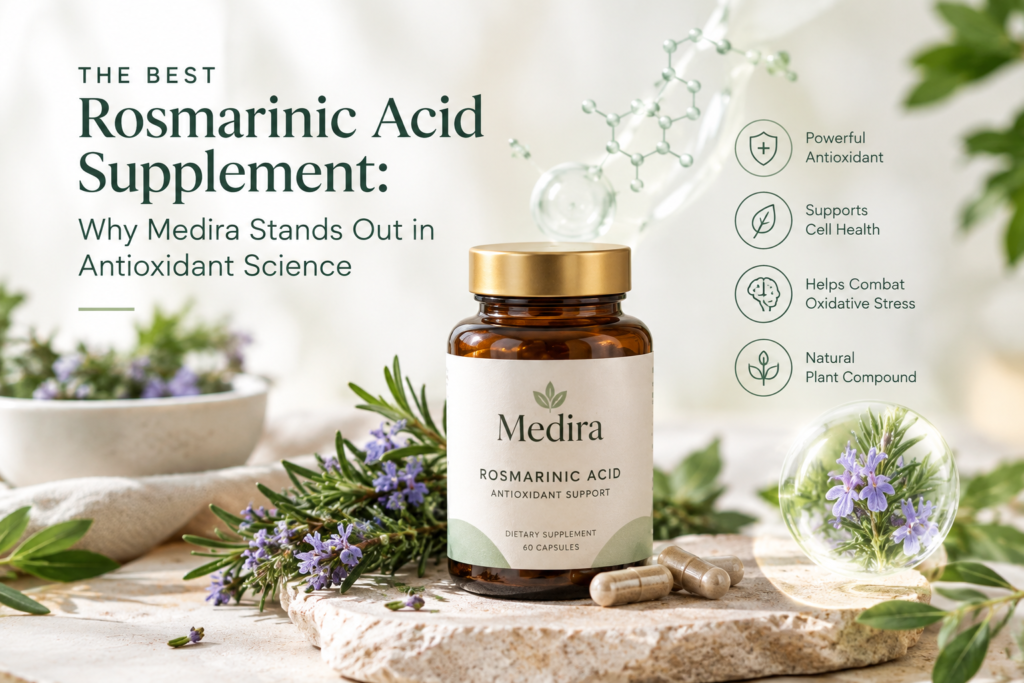
Medira is a unique supplement that combines four plant hydrosols, rosmarinic acid, and honey—creating a multi-layered antioxidant defense system.
The Four Hydrosols
Hydrosols (also called floral waters) are the water-soluble byproducts of essential oil distillation. They contain terpenes and terpenoids—compounds with potent antioxidant, anti-inflammatory, and antimicrobial properties
| Plant | Key Active Compounds | Antioxidant Contribution |
|---|---|---|
| Rosemary (Rosmarinus officinalis) | Verbenone (41.8%), Borneol (10.9%), α-Terpineol (8.3%), 1,8-Cineole (6.4%) | Potent ROS scavenger; reduces lipid peroxidation |
| Lavender (Lavandula angustifolia) | Linalool (19.6%), Terpinen-4-ol (17.0%), α-Terpineol (13.6%) | Superoxide anion scavenging |
| Fennel (Foeniculum vulgare) | Fenchone (40%), 1,8-Cineole (5.3%), Estragole (4.4%) | Complementary antioxidant effects |
| Juniper (Juniperus oxycedrus) | 4-Methyl-2,6-bis(1,1-dimethylethyl)-phenol (14.8%), α-Terpineol (7.6%) | Significant TOS reduction |
Rosmarinic Acid: The Star Player
Rosmarinic acid (RA) is a phenolic compound first isolated from rosemary. It’s recognized as a healthy and effective antioxidant with multiple mechanisms of action:
- Direct ROS scavenging – RA neutralizes free radicals by donating hydrogen atoms from its hydroxyl groups
- Enzyme modulation – Inhibits xanthine oxidase (a source of ROS) and boosts endogenous antioxidants like SOD, catalase, and glutathione peroxidase
- Membrane protection – Penetrates cell membranes to inhibit lipid peroxidation from within
- DNA repair induction – Unlike many antioxidants, RA actively promotes repair of already-damaged DNA
Research shows RA can reduce intracellular ROS by 80.4% and MDA (a lipid peroxidation marker) by 73%, while increasing SOD activity by 126% and catalase by 114%. It also protects against UVB-induced oxidative damage and PM2.5-induced apoptosis
Honey: Nature’s Antioxidant Reservoir
Honey isn’t just sweet—it’s a complex matrix of polyphenols, flavonoids, phenolic acids, vitamins C and E, enzymes (catalase, peroxidase), and trace minerals.
The antioxidant capacity of honey directly correlates with its polyphenolic content. Darker honeys generally exhibit higher antioxidant activity due to greater concentrations of these compounds
The Science: What Research Reveals About Medira
A landmark in vitro study evaluated Medira’s antioxidant activity using human serum samples. Researchers measured six key oxidative stress parameters:
Key Antioxidant Parameters
| Parameter | What It Measures |
|---|---|
| TAS (Total Antioxidant Status) | Overall reducing capacity of all antioxidants in serum |
| SHG (Sulfhydryl Groups) | Protein-based antioxidant reserves (first line of defense) |
| PON1 (Paraoxonase-1) | HDL-associated enzyme that prevents LDL oxidation |
| TOS (Total Oxidative Status) | All oxidizing substances (H₂O₂, lipid hydroperoxides) |
| PAB (Prooxidant-Antioxidant Balance) | Simultaneous measure of oxidants vs. antioxidants |
| AOPP (Advanced Oxidation Protein Products) | Marker of oxidative protein damage |
The Results Were Striking
Without a prooxidant challenge:
- Medira showed significantly higher TAS, SHG, and PON1 compared to both serum controls and Trolox (a vitamin E analog)
- Medira showed significantly lower PAB and AOPP—meaning better balance and less protein damage
- The TAS/TOS ratio—a quantitative measure of antioxidant-to-oxidant balance—was substantially higher with Medira
With a prooxidant (TBH) challenge:
- Medira maintained significantly higher TAS and SHG even in the presence of oxidative stress
- PAB remained significantly lower—the balance stayed in Medira’s favor
- No significant difference was observed between Medira samples with and without the prooxidant for TAS, TOS, PAB, or TAS/TOS ratio
The takeaway: Medira maintained its antioxidant protection even when challenged with a strong oxidant
How Medira Compares to Vitamin E
When compared to Trolox (a water-soluble vitamin E analog), Medira demonstrated:
- Higher TAS and SHG (more total antioxidant capacity)
- Lower PAB (better prooxidant-antioxidant balance)
- Superior performance even when Medira faced TBH while Trolox didn’t
This suggests Medira’s synergistic combination of compounds outperforms a single antioxidant like vitamin E
How to Reduce Oxidative Stress: A Comprehensive Strategy
While Medira offers powerful support, reducing oxidative stress requires a multi-faceted approach:
1. Adopt an Antioxidant-Rich Diet
Plant-based foods are the best source of antioxidants. Focus on:
- Colorful fruits and vegetables (berries, leafy greens, tomatoes, peppers)
- Whole grains, nuts, and seeds
- Herbs and spices (rosemary, oregano, turmeric, cinnamon)
- Dark chocolate and cocoa
Aim for at least 3-7 servings of vegetables and 1-2 servings of colorful fruits daily
2. Consider Targeted Supplementation
Medira’s unique formulation offers comprehensive antioxidant support through:
- Rosmarinic acid – Multi-mechanism protection at the cellular level
- Terpenes from four hydrosols – Diverse antioxidant actions
- Honey polyphenols – Broad-spectrum free radical scavenging
This synergistic effect means the whole is greater than the sum of its parts—Medira’s combined compounds work together to provide more robust protection than any single ingredient alone.
3. Lifestyle Modifications
- Prioritize sleep – Inadequate sleep increases oxidative stress
- Exercise regularly – Moderate exercise boosts endogenous antioxidants
- Avoid smoking and limit alcohol
- Minimize environmental toxin exposure – Use air purifiers, choose clean personal care products
Why Synergy Matters: The Medira Advantage
Medira’s effectiveness isn’t just about individual ingredients—it’s about how they work together:
Medira’s effectiveness isn’t just about individual ingredients—it’s about how they work together:
- Rosmarinic acid provides comprehensive cellular protection, penetrating membranes and boosting endogenous antioxidants
- Terpenes from hydrosols offer complementary free radical scavenging, with different compounds targeting different types of ROS
- Honey’s polyphenols add broad-spectrum protection and lipophilic compounds that protect cell membranes
This multi-layered defense explains why Medira outperformed vitamin E in the study—and why it maintained its effectiveness even under oxidative challenge.
Conclusion: Taking Control of Your Cellular Health
Oxidative stress is a silent contributor to many of today’s most prevalent diseases. But you don’t have to accept it as inevitable.
Medira offers a science-backed, natural approach to reducing oxidative stress. With its unique combination of rosmarinic acid, four plant hydrosols, and honey, it provides comprehensive antioxidant protection that has been validated by in vitro research.
The path to better cellular health starts with understanding the problem—and choosing solutions that work with your body, not against it.
Ready to Support Your Cellular Health?
Medira combines nature’s most powerful antioxidants into one convenient supplement. Backed by scientific research and crafted from high-quality ingredients, it’s designed to help you maintain the balance your cells need.
👉 [Learn more about Medira and how it can support your health journey]